

The Ocean Oxygen to Carbon Heat Nexus in a Warming Climate (O2CH)
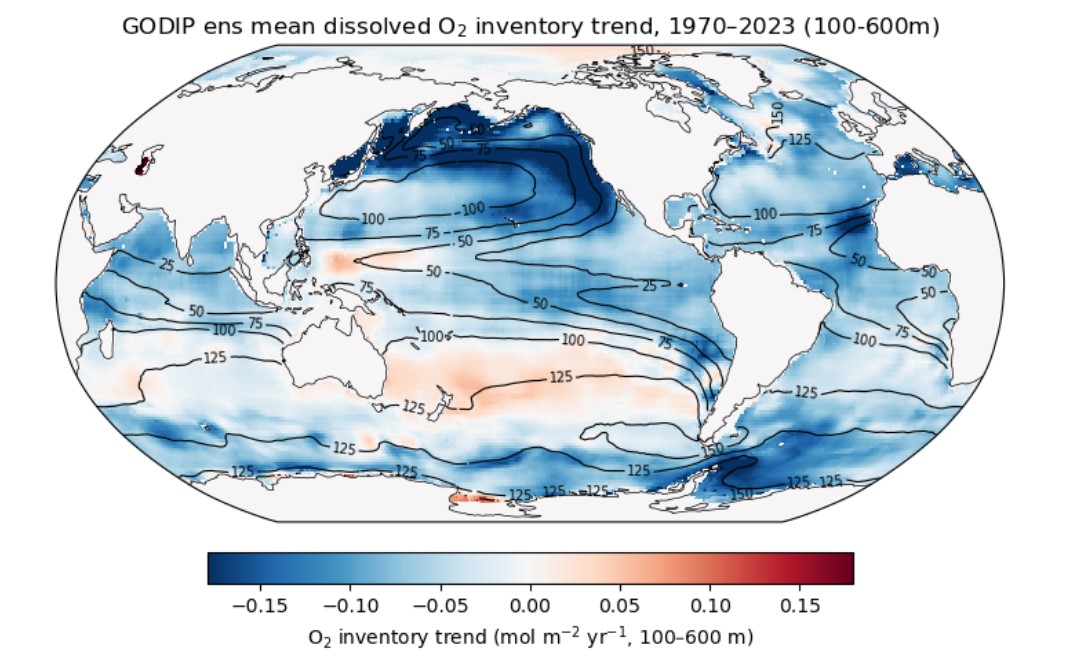
The Earth’s climate and ecosystems are shaped by the three interconnected factors: oxygen, carbon, and heat. Together, these act like vital signs that reveal the health and the future trajectory of our planet’s climate. The oceans are the major sink of anthropogenic carbon and heat, while declining dissolved oxygen levels have been observed in all ocean basins with far reaching influences on the Earth’s marine habitats and the ocean’s natural chemical cycles. On the global scale, the three tracers are clearly coupled; however, little is understood about their regional-scale coupling because of internal redistribution and different physical and biogeochemical processes involved, which is crucial to project future changes in regional ecosystem and habitat changes.
This research focus will investigate the intertwined dynamics of oceanic heat and the cycling of carbon and oxygen under the pressure of accelerating anthropogenic warming, with ocean oxygen as the central element. By integrating new and existing observations, models, and theory, and leveraging on existing international projects, we seek to uncover the linkages, feedbacks, and thresholds that connect the physical climate system to ocean chemistry and biology. We also aim to bring together researchers who currently study ocean heat, oxygen and carbon separately, breaking down the barriers between these fields.
The O2CH RF has been established in July 2026.
Terms of Reference
- To advance understanding of the ocean oxygen change and its variability, and the coupling between oxygen (O2), heat, and carbon in a warming climate through the achievement of the RF Objectives, and report the activities to the CLIVAR Scientific Steering Group. RF leads will attend the CLIVAR SSG meeting and periodically update the SSG about the progress.
- To build a collaborative, cross-disciplinary community for oxygen-related research, bringing together physical and biogeochemical scientists working on the oxygen, carbon cycle, climate dynamics, ocean observing system, ocean/climate model, and reanalysis.
- To promote interaction amongst the synergistic community through workshops, publications, and other activities on intercomparison, development, and sharing of multiple observation datasets towards a better understanding of processes in oxygen, heat, and carbon cycling, and their interactions, as well as observational uncertainty. RF website will be established to provide links to the webinar series, and will feature O2CH-related activities and relevant publications.
- To identify gaps in climate observing systems, model developments, and process understanding, and suggest ways forward.
- To inform IPCC-AR7 and other major international assessments on ocean oxygen changes and processes, the establishment of climate/ocean indicators, and the Global Ocean Observing System design for O2. RF activities will contribute to the IPCC AR7 WGI report.
- To increase the capability of the international community (especially students and early career researchers; researchers from less developed countries) to better reach the tools (providing guidance and access to data products and model simulations, making data mapping methods available for regional customization, and disseminate the workflow via online tutorials) related to ocean oxygen, and increase the awareness of the O2/heat/carbon research to the scientific community and general public; communicate knowledge needed by society to secure a healthy ocean.