


How does ENSO influence the O2 content and distribution in the tropical Pacific?
How does ENSO influence the O2 content and distribution in the tropical Pacific?
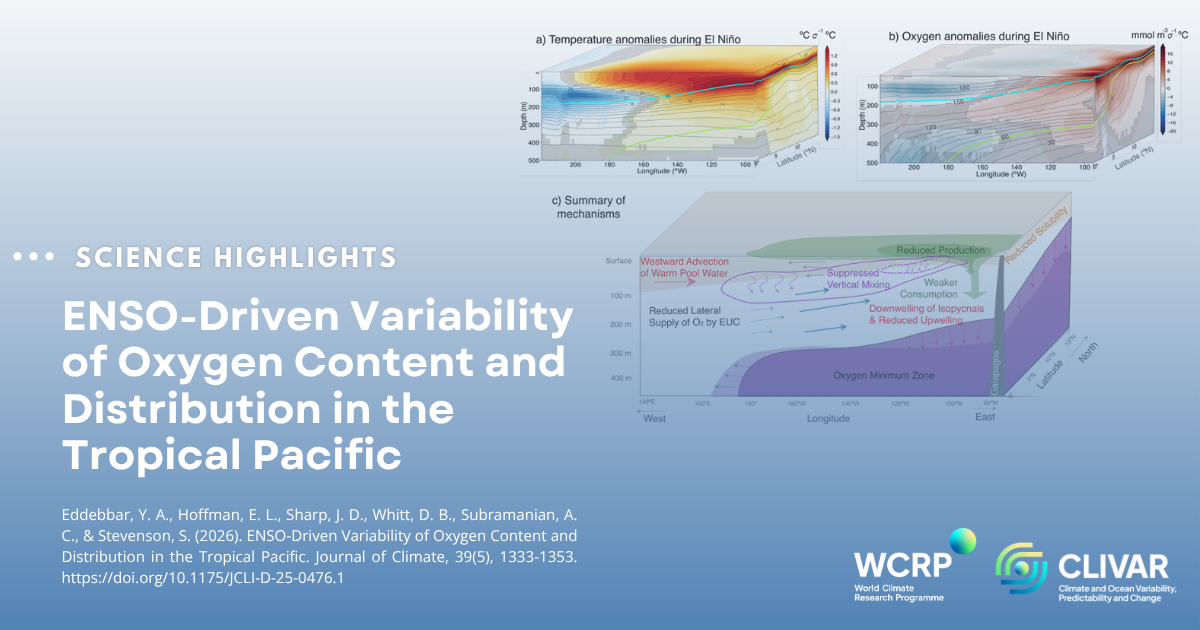
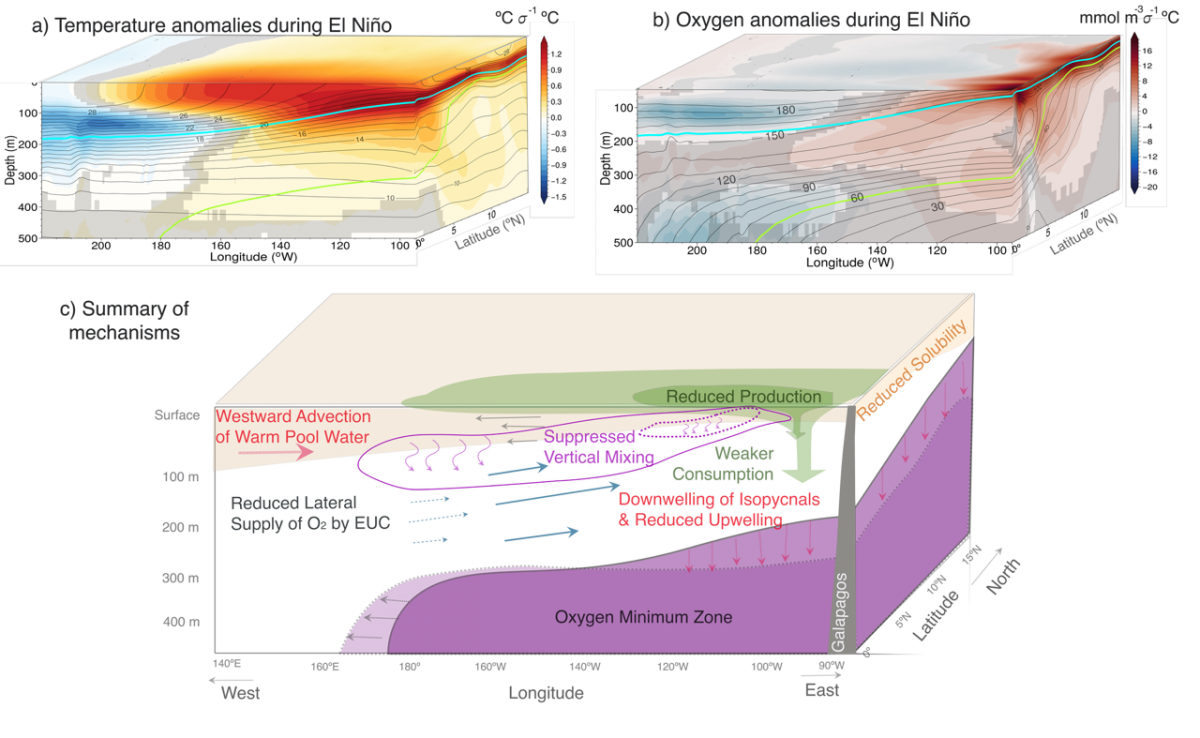
ENSO has long been known to have a major influence on marine ecosystems in the tropical Pacific. A critical but poorly understood link between the marine ecosystem changes and ENSO dynamics concerns the response of dissolved oxygen (O2), a key driver of ecosystem habitats and biogeography. Sparse observations and coarse models have historically shown a large influence of ENSO on local O2 concentrations, but a detailed assessment of how ENSO impacts the integrated O2 content, its large-scale distribution in the tropical Pacific, and underlying mechanisms remain poorly know. This study uses high- and low-resolution simulations of the Community Earth System Model (CESM) along with machine learning-based estimate of O2 from BGC Argo floats to evaluate the tropical Pacific O2 response to ENSO. Across models and observations-based estimates, ENSO is found to be a dominant driver of the interannual variability in the tropical Pacific O2 content and distribution, with El Niño driving an increase in the eastern tropical Pacific O2 content that’s compensated in the western Pacific by a decrease, while La Niña generally induces the opposite response. We focus on the eastern Pacific O2 response where low-O2 conditions naturally prevail, and where ENSO perturbations have a drastic influence on marine ecosystem habitats and productivity. In this region, ENSO-induced O2 variability is mediated by large compensations between physical and biogeochemical processes, whereby the suppression of upwelling reduces the upward transport of low-O2, nutrient-rich waters, reducing O2 consumption at depth. The resulting O2 increase is balanced - though only partially - by large reductions in O2 ventilation due to weaker zonal supply by the Equatorial Undercurrent and vertical mixing as the easterlies slow down and the lateral shear weakens during El Niño. Conversely, La Niña events intensify O2 ventilation but upwelling of low-O2 waters and intensified O2 consumption dominate the net balance, yielding a lower O2 content in the eastern tropical Pacific. The complex nature of the O2 response to ENSO suggests that future changes in the tropical Pacific O2 content and distribution may be similarly mediated by local changes in tropical Pacific dynamics as well large-scale changes in ventilation from the mid and high latitudes as the ocean warms.
Authors:
Yassir A. Eddebbar (Scripps Institution of Oceanography)
M L. Hoffman (Scripps Institution of Oceanography)
Jonathan D. Sharp (UW/NOAA)
Daniel B. Whitt (NASA Ames)
Aneesh C. Subramanian (CU Boulder)
Sam Stevenson (UC Santa Barbara)
Eddebbar, Y. A., Hoffman, E. L., Sharp, J. D., Whitt, D. B., Subramanian, A. C., & Stevenson, S. (2026). ENSO-Driven Variability of Oxygen Content and Distribution in the Tropical Pacific. Journal of Climate, 39(5), 1333-1353. https://doi.org/10.1175/JCLI-D-25-0476.1